
Simple Duct
That flexible silver hose behind your dryer may look harmless. But what it's made of — and where it's installed — can make a big difference.
Most homeowners rarely think about the ventilation system behind their clothes dryer.
It's hidden behind the appliance, inside a wall, above the ceiling, or sometimes running through the attic.
As long as the dryer seems to be working, why would anyone think about it?
But after more than five years of working on dryer ventilation systems throughout New York and New Jersey, our founder learned that the wrong type of duct can create problems that homeowners never see.
One issue appeared repeatedly: thin, flexible foil ducting being used where a more durable metal connection — or a proper permanent metal exhaust duct — belonged.
Sometimes the problem was right behind the dryer. Other times, it was hidden deep inside the home.
Not every silver dryer vent hose is the same. And not every type belongs in the same place.
Here's what homeowners should know.
1. Three Types of Dryer Vent Ducts — And Why They're Different
At first glance, several types of dryer ducting may look almost identical. They're silver. They're round. And they're designed to carry air.
But their construction and intended uses can be very different.
Flexible Foil Duct
Lightweight. Easy to bend. Easy to damage.
Flexible foil duct is the soft, shiny, accordion-style hose often found behind dryers.
Many products are constructed from thin aluminum foil layers, sometimes combined with polymer film, supported by a spiral wire frame.
These hoses are lightweight, inexpensive, and easy to install. Unfortunately, that flexibility can also make them vulnerable to crushing, kinking, tearing, and punctures.
Some foil-type dryer transition ducts are listed under UL 2158A and may be permitted in certain installations. However, that does not make them suitable substitutes for the permanent metal exhaust ducts running through a home.
Semi-Rigid Aluminum Duct
More durable. Made from formed metal. Designed for suitable connections.
Semi-rigid aluminum ducting may also have an accordion-like appearance.
Unlike many foil-laminate products, it is formed from aluminum metal. It is generally more durable and better able to maintain its shape when correctly installed.
An appropriately listed and labeled semi-rigid metal duct can be a suitable option for connecting a dryer to the permanent exhaust system. But even a semi-rigid metal connector must comply with the appliance manufacturer's instructions and applicable installation requirements.
Rigid Metal Exhaust Duct
A smooth metal path for the permanent ventilation system.
Rigid metal ducting is used for the permanent exhaust route through the home. It has a smooth interior surface that helps air and lint move toward the outdoor exhaust termination.
Permanent dryer exhaust ducts must meet applicable construction, thickness, diameter, installation, and routing requirements. They are not interchangeable with thin flexible foil hoses.
The important difference isn't simply how shiny a pipe looks. It's what the pipe is made from and where it is intended to be installed.
2. Problem One: Flexible Foil Ducts Can Be Easily Damaged
Think about what happens behind a dryer.
Someone pulls the appliance away from the wall to clean. A technician moves it during maintenance. A homeowner pushes it back into position.
A soft foil duct can become compressed, twisted, or sharply bent. Sometimes it develops tears or holes. And because the connection is hidden behind the machine, no one notices.
What happens when the duct is crushed?
When the exhaust path becomes restricted, hot, moist air has a harder time escaping.
That can lead to:
- Longer drying times.
- Clothes remaining damp after a normal cycle.
- Increased heat buildup.
- Lint accumulating in restricted areas.
- Air or lint escaping through damaged connections.
The U.S. Consumer Product Safety Commission warns that flexible plastic and foil accordion-style ducts are more susceptible to crushing and kinking than suitable metal alternatives.
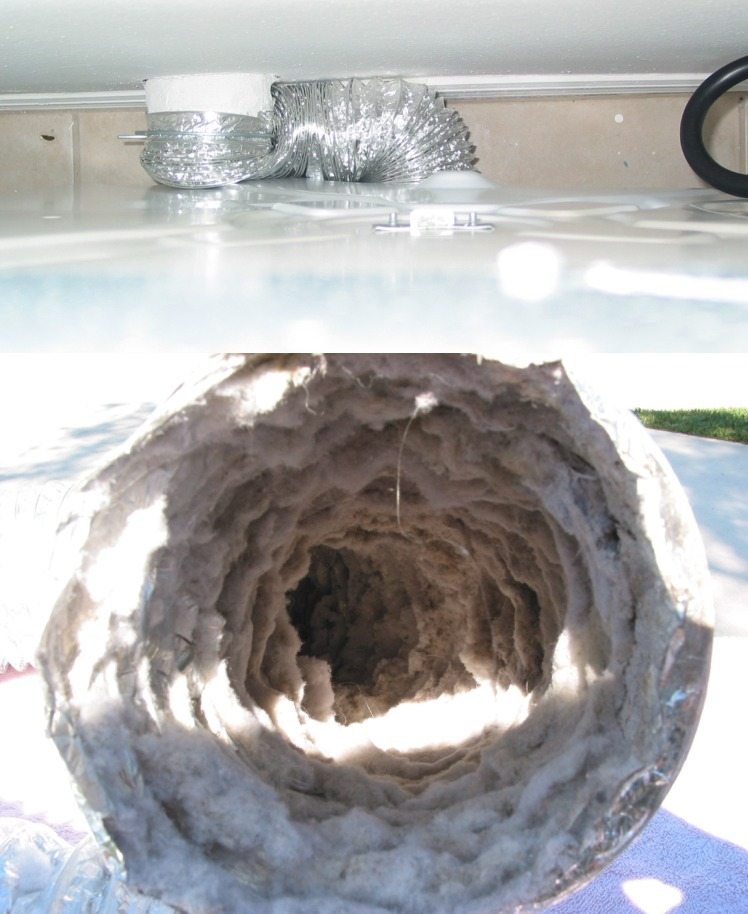
An actual example of a severely kinked dryer vent connection and lint accumulation. Photo: Rick Harpenau, CC BY 3.0, via Wikimedia Commons. Re-encoded with metadata removed; image content unchanged.

A dryer that suddenly needs two cycles to dry a normal load may have a ventilation problem — even if the appliance itself is operating.
Sometimes the problem isn't your dryer. It's the connection hidden behind it.
Source: U.S. Consumer Product Safety Commission
3. Problem Two: Heat, Lint, and Fire Safety
A dryer produces heated air that must travel through the ventilation system and exit outdoors. Lint can accumulate both inside the appliance and along the exhaust path.
When airflow is restricted, heat can build up. Under the wrong conditions, accumulated lint and excessive heat can contribute to a fire.
This is why the condition of the dryer exhaust system matters.
Thin foil ducting presents additional concerns because its flexible, ribbed construction can be more easily damaged or restricted. Some foil products also contain polymer layers and have different heat-performance characteristics from solid metal ducting.
A product's actual fire performance depends on its construction and safety listing. It would be inaccurate to claim that every foil duct ignites during normal use. It would also be inaccurate to describe rigid metal ducting as completely fireproof.
The important point is that properly selected materials and proper airflow reduce avoidable hazards.
What does the U.S. Fire Administration recommend?
In its report Clothes Dryer Fires in Residential Buildings (2008–2010), the U.S. Fire Administration discusses problems associated with flexible venting, including twisting and lint accumulation.
Its dryer safety recommendations include replacing coiled-wire foil or plastic venting with rigid, non-ribbed metal duct.
Source: U.S. Fire Administration — Dryer Fire Safety Report
The U.S. Consumer Product Safety Commission also recommends replacing plastic or foil accordion-type ducting with rigid or corrugated semi-rigid metal duct.
Source: CPSC — Overheated Clothes Dryers Can Cause Fires
A dryer vent needs more than occasional cleaning. It needs the right materials, a proper installation, and an unobstructed path outdoors.
4. What I Saw Working in New York and New Jersey
Sometimes the Problem Was Hidden in the Attic
During years of servicing dryer ventilation systems throughout the New York and New Jersey metropolitan area, our founder encountered installations that needed more than routine lint removal.
Some problems were immediately visible behind the dryer. Others required examining sections of the ventilation system hidden elsewhere in the home.
One particularly concerning type of installation involved permanent metal exhaust ducts that had been removed, disconnected, or replaced with long sections of soft flexible foil hose.
In some cases, the flexible sections were approximately 10 feet long and ran through attic spaces.
To an unsuspecting homeowner, this could look like an ordinary repair. After all, the air might still have a path from the dryer toward the outside.
But there was a fundamental problem.
A flexible dryer transition hose is not a substitute for the permanent metal exhaust duct running through your home.
Why is a long flexible section a problem?
A long foil hose may sag between its supports. It can become crushed, twisted, or damaged. Its folds may create places where lint accumulates.
And a section hidden in an attic may remain unnoticed for years.
The homeowner may only notice that the dryer takes longer to finish a load. Or they may not notice any obvious symptoms at all.
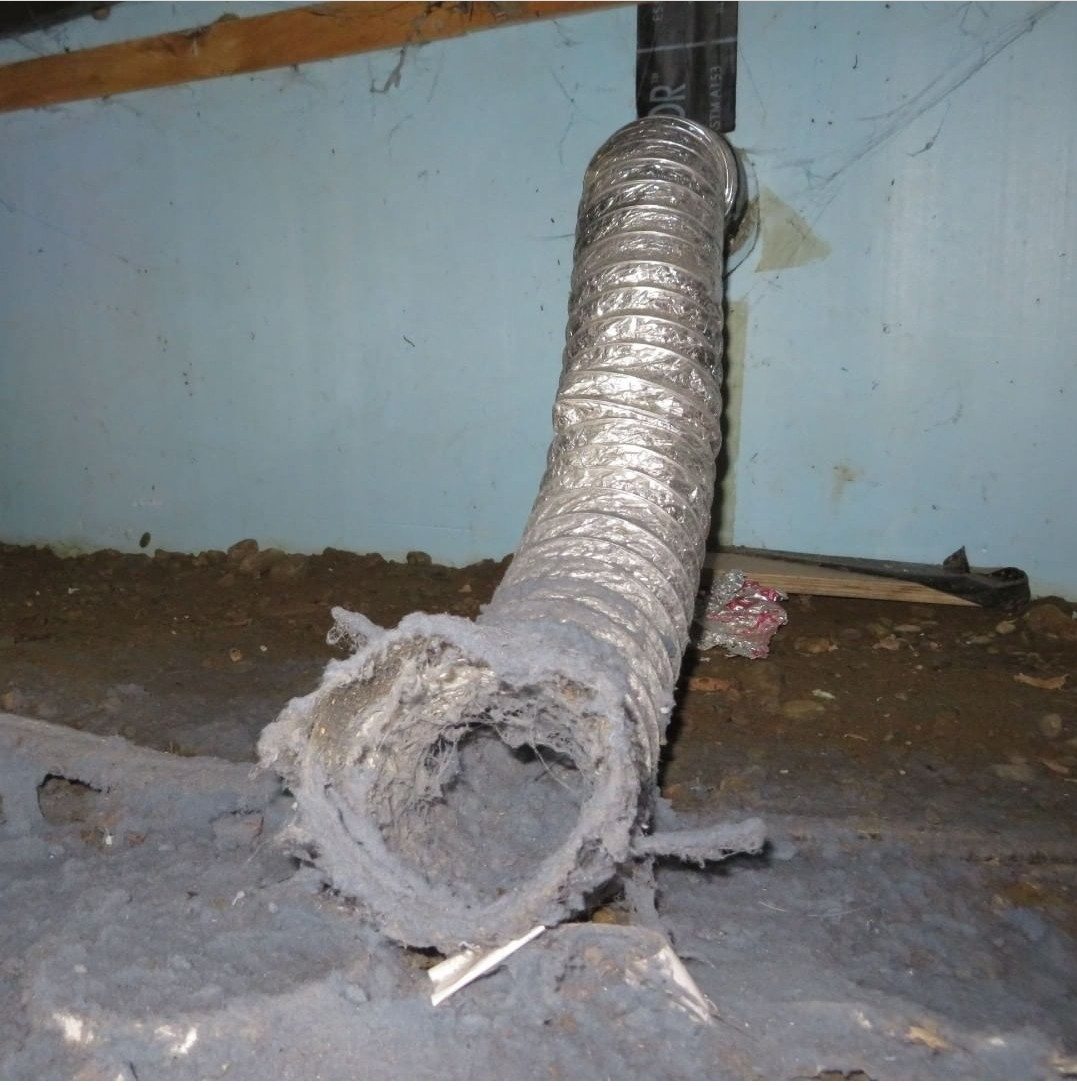
A long section of flexible foil hose used in place of permanent ductwork, found disconnected and packed with lint — from the founder's New York service years.
During commercial service work in New York and New Jersey, our founder also encountered properties where site safety requirements called for replacing unsuitable flexible connections with appropriate metal ducting.
Those experiences reinforced an important lesson:
A ventilation system can look connected and still be improperly installed.
5. The Rule Every Homeowner Should Understand
A Dryer Connection Is Not the Same as a Permanent Exhaust Duct
There are two separate parts of a typical dryer exhaust system.
A. The Transition Duct Behind the Dryer
This is the short connection between the appliance and the permanent exhaust system.
Under Section M1502.4.3 of the 2021 International Residential Code, a dryer transition duct must:
- Be a single length.
- Be listed and labeled in accordance with UL 2158A.
- Be no longer than 8 feet.
- Not be concealed within construction.
The appliance manufacturer's instructions may establish additional restrictions.
Certain listed foil-type transition ducts may be permitted in specific situations, while other dryers require different venting materials. The manufacturer's instructions matter.
B. The Permanent Exhaust Duct
This is the exhaust route that carries dryer air through the home and outdoors.
Under Section M1502.4.1 of the 2021 International Residential Code, the permanent exhaust duct must have a smooth interior finish and be constructed from metal at least 0.0157 inch thick (28 gauge), with a nominal diameter of 4 inches.
Additional requirements govern its installation, length, fittings, and termination.
A long flexible foil hose installed in place of permanent metal ductwork does not become an acceptable permanent exhaust duct simply because it connects two pieces of metal pipe.
Even a short flexible transition connector should not be used to replace a missing section of permanent exhaust duct.
A dryer exhaust route passing through an attic must also continue to an approved outdoor termination. Dryer exhaust must not discharge into the attic.
These distinctions are especially relevant in Aurora, Colorado, where the city lists the 2021 International Residential Code among its adopted construction codes. Local amendments, manufacturer instructions, and the requirements for the specific property still need to be considered.
Sources:
- 2021 International Residential Code — Chapter 15
- City of Aurora — Adopted Building Codes
- GE Appliances — Dryer Exhaust Duct Installation
6. Why Cleaning Alone Cannot Fix a Bad Installation
This is one of the most important things we want homeowners to understand.
Dryer vent cleaning removes lint and debris from the exhaust path. But cleaning cannot correct every problem.
It cannot repair a torn hose. It cannot reconnect missing ductwork. It cannot transform an unsuitable flexible duct into a code-compliant permanent metal exhaust system. And it cannot correct an improper route that discharges into an attic instead of outdoors.
A dryer vent can be clean and still be improperly installed.
That's why recognizing damaged or unsuitable components matters.
A qualified technician should explain what was found, why it matters, and whether it affects safe operation.
Homeowners deserve accurate information, not an unexpected sales pitch.
7. Five Warning Signs Homeowners Can Recognize
You don't need to understand building codes to notice some common problems.
1. Your dryer takes longer to dry clothes
Restricted airflow may be one possible cause.
2. The hose behind your dryer is flattened or crushed
The connection may be restricting the exhaust airflow.
3. You can see tears, holes, or disconnected fittings
Lint and warm, moist air may be escaping where they shouldn't.
4. You notice a long, sagging flexible hose in the exhaust system
The installation may need professional evaluation, particularly if the flexible material has replaced part of the permanent exhaust route.
5. You notice unusual overheating, smoke, or a burning smell
Stop using the dryer until the cause has been identified. Burning odors can have several causes, including electrical or mechanical problems.
If there is smoke, a suspected active fire, or an immediate danger, leave the area and contact emergency services.
Safety first: Don't pull out a heavy dryer, disconnect gas piping, or enter an unsafe attic just to inspect the duct. Ask a qualified professional when the connection is difficult or dangerous to access.
8. The Simple Duct Approach: Honest Information, No Pressure
One of the reasons Simple Duct was created was the frustration our founder saw when homeowners paid for services that didn't fully address their problems.
Sometimes the issue was incomplete cleaning. Sometimes a vent was damaged or improperly installed. And sometimes the homeowner simply hadn't been told about an existing problem.
We believe homeowners deserve better.
At Simple Duct, our approach is straightforward.
If we discover a damaged dryer vent connection or an unsuitable section of ducting, we'll explain what we found in plain English. We'll document the problem when possible. And if we identify a potential safety concern, we'll tell you clearly.
But we won't automatically add repair charges to the cleaning service you've already booked.
We don't believe a technician should turn a routine visit into a high-pressure sales opportunity.
We come to do the work you booked. Not to sell you more.
The Bottom Line
The short silver hose behind your dryer may seem like a minor detail. And the permanent exhaust pipe hidden inside your home may be something you've never seen.
But both matter.
Thin flexible foil ducting can be more vulnerable to damage and airflow restrictions. Properly selected semi-rigid metal ducting can be a more durable option for an appropriate dryer connection. And the permanent exhaust system must use suitable metal ductwork that meets applicable requirements.
Cleaning removes lint. Proper installation gives exhaust air and lint a suitable path out of your home.
At Simple Duct, we believe good service starts with honest information.
No pressure. No unnecessary sales. No surprise charges for the work you've booked.
Because home safety should never come with a sales pitch.
Need Your Dryer Vent Cleaned?
Simple Duct serves homeowners throughout the Denver metro area.
Choose your service, see your price, and book your appointment online.
Straightforward service. Clear pricing. No sales pitch.